How to Choose the Best Brand Identity Agency in Singapore: A Founder's Framework
The best brand identity agency in Singapore leads with brand strategy before visual execution, keeps senior practitioners on the account from audit to launch, and treats identity as the visible expression of a rigorously defined position rather than decoration applied to a weak foundation. That definition matters because most "top agency" lists rank on portfolio polish and award counts, and a logo built on an unclear positioning brief tends to be quietly redesigned within eighteen months.
For a founder or marketing lead weighing partners, the harder question is which operating model actually delivers craft over the long horizon. A polished mark with no strategic backbone will drift; a modest identity anchored in a sharp positioning will compound.
We are Delitier & Co, a Singapore-based branding and digital-first agency. We built our practice around one conviction: strategy before decoration, senior people on every engagement, and the pace craft actually requires. This guide sets out the criteria we would use to shortlist a brand identity partner, how branding agencies, full-service, and design-only models differ in what they deliver, and what a rigorous engagement should look like inside a market as competitive and culturally layered as Singapore's.

Key Takeaways
Brand identity without brand strategy is decoration. A sharp positioning has to come first, and identity work that skips the audit and the strategic brief tends to be redesigned within eighteen months.
Operating model matters more than agency size. A smaller, senior-led team keeps the practitioners on your account, whereas larger networks often pitch with seniors and deliver with juniors, and design-only studios execute beautifully but leave the strategic thinking to you.
Singapore's four-language, multi-ethnic market rewards identity systems that travel. The right agency shows how its work behaves across English, Mandarin, Malay and Tamil audiences, and across every channel from shopfront to Shopee.
What brand identity actually is and where the search usually goes wrong
Brand identity is the visible, verbal, and behavioural expression of a brand's underlying strategy: logo, colour system, typography, imagery, voice, tone, and every touchpoint the brand controls. It is not the same thing as brand strategy, and it is not the same thing as graphic design.
The search for a brand identity agency often collapses those distinctions. A studio that produces a beautiful wordmark has done design work; a consultancy that defines your positioning, audience, and category role has done strategy work. Brand identity sits between them, as the discipline that translates the strategy into a coherent, durable system the business can actually use.
The consequence of conflating them is expensive. Founders commission an identity without a positioning brief, receive a polished visual system, and discover a year later that nothing about the identity actually distinguishes the business. The remedy is not another round of design; it is the strategic work that should have preceded the first sketch.
We define a brand identity engagement as inseparable from the brand strategy that authors it. Audit first, position second, express third. When those three sit in the wrong order or when the first two are skipped, the visible brand has nothing to hold on to.
Why strategy has to come before the visual identity
A brand identity built without a strategic foundation is a decoration exercise, not an asset and the market can tell. In our experience, a brand identity that outlasts its category cycles is doing strategic work: signalling positioning, cueing audience, defending category role.
Strategy answers the questions the identity then has to express. What does the brand stand for? Who is it for, and where does it deliberately not play?
Identity then translates those answers into form. A colour palette that reinforces the positioning. A typography system that carries the voice, and a logo mark that becomes shorthand for the whole idea over time.
Skip the strategy, and the identity is guessing. Skip the identity, and the strategy has no shopfront. The two are one job, sequenced correctly.
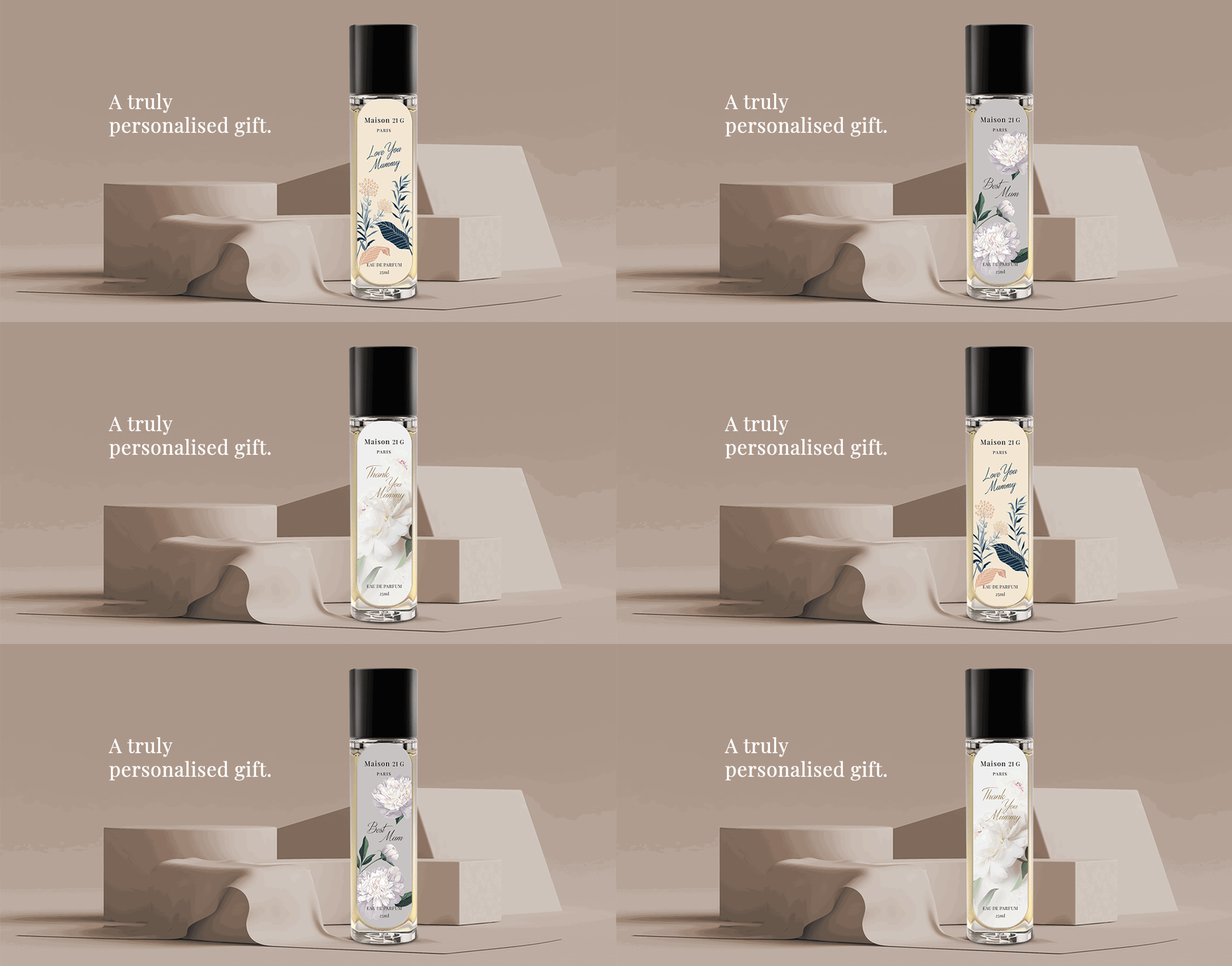
Our approach to a brand identity engagement always begins with the strategic groundwork: a brand audit, positioning workshops, and a written strategic brief before any visual work starts. In our work with Monarchs & Milkweed and Maison 21G, that discipline meant the identity had a single ownable idea to express, not a mood board looking for a home.
The five criteria to weigh when evaluating a brand identity agency
Evaluate a brand identity agency on five criteria before the portfolio: strategic depth, senior involvement, methodology, cultural fluency, and evidence of long-horizon craft. Portfolio polish is the last screen, not the first. A weak brief hidden behind beautiful renders is still a weak brief.
The five, in order of weight:
Strategic depth. Ask how they define positioning, and how positioning informs the identity brief. If the answer starts with colour and typography, they are a design supplier and not a brand identity partner.
Senior involvement. Ask who will be on your account week to week, not who is in the pitch room. The gap between the pitch team and the delivery team is where most engagements quietly lose the plot.
Methodology. Ask for the process of audit, positioning, identity, application, governance. A repeatable method is what turns craft into an accountable engagement.
Cultural fluency. In Singapore, ask how the identity behaves across English, Mandarin, Malay and Tamil audiences, and across the physical and digital channels the brand will actually appear in.
Long-horizon craft. Ask to see identities they built five years ago that still hold. Anyone can produce a launch-day render; the harder question is whether the system was durable.
We would weigh the first two as the heaviest. Strategy and senior involvement are the pair that predict the outcome; methodology and cultural fluency protect it under pressure. Portfolio is confirmation, not proof.
How branding, full-service, and design-only models compare
The operating model of a brand identity agency shapes what you actually receive, often more than the portfolio does. Three models dominate the Singapore market, and each is optimised for a different kind of engagement.
Some branding agencies run small, senior-led teams. The practitioners who pitch are the practitioners who deliver. The trade-off is capacity with fewer engagements at once is why lead times are longer and why the work tends to be more considered.
Full-service networks operate at scale. They cover strategy, identity, digital, campaign, and media under one roof. The trade-off is delivery: the seniors who present the pitch often hand off to junior teams for execution, and the strategic thinking can thin as it travels down the ladder.
Design-only studios produce beautiful visual work quickly. The trade-off is scope: if you already have a defined positioning and a clear brief, they will execute it well; if you do not, you will need to bring the strategy from elsewhere.
Here is how the three compare on the dimensions that matter to a premium or lifestyle brand:
| Dimension | Branding agency | Full-service network | Design-only studio |
|---|---|---|---|
| Strategy included | Yes, leads the engagement | Yes, but often thins in delivery | No, expects a brief |
| Senior involvement | Practitioners work directly on your account | Senior at pitch, junior in delivery | Depends on studio size |
| Pace | Considered, craft-led | Fast, deadline-driven | Fast, visual-led |
| Cultural fluency | Deep local read if practitioners live the market | Standardised across regions | Varies by team |
| Best for | Founders wanting strategy-led identity | Multinationals rolling out global systems | Brands with a clear brief and fast turnaround |
| Trade-off | Limited capacity | Delivery quality varies | Strategy sits with the client |
The question is not which model is superior, but which model matches the engagement in front of you. A well-briefed multinational rebrand may be well served by scale; a founder building the brand for the first time will usually be better served by strategy-led branding attention.
We are a digital-first branding agency by choice. The size is deliberate as it buys senior attention on every account, and the freedom to work at the pace craft actually requires.
Singapore's brand economy and what it demands of identity work
Singapore's brand economy is measurable, competitive, and multilingual. Identity work here has to travel across four languages, several ethnicities, and every channel from shopfront to feed. The market rewards discipline; it punishes generic.
Singapore's top 100 brands reached a combined value of S$78.4 billion in 2025, and the underlying design economy is scaling with it. The graphic design market was worth USD 2.1 billion in 2024, projected to reach USD 3.7 billion by 2033. The commercial ceiling for well-built brands here is high, which is why the standard for identity work has risen with it.

The four-language reality
Identity systems in Singapore have to hold in English, Mandarin, Malay, and Tamil. Not as translated afterthoughts, but as native expressions. Typography choices that read cleanly in one script may collapse in another; colour codes that signal premium to one audience may read differently to another.
In our experience, the identity work that lasts is the work that was designed with all four audiences in mind from the strategy stage, not retrofitted at rollout.
The physical-digital continuum
A brand identity in Singapore has to behave equally well on an MRT panel, a shopfront, a Shopee tile, and an Instagram feed. The same wordmark, the same colour system, the same voice across every touchpoint, at every crop, at every scale.
A design that only works at hero size is a design that has half a job. We test identity systems at the smallest and least favourable applications before we test them at the campaign shot.
The premium-segment expectation
Premium and lifestyle buyers in Singapore judge quickly, and they are not patient with brands that feel generic. A luxury retail identity that reads like FMCG will lose the customer at the shopfront; a boutique beauty identity that leans mass-market signals will lose credibility on the shelf.
Our brand work for Skin Inc, Haach, and Bio-Oil across the beauty and wellness space had to hold in exactly those conditions: considered, ownable, unmistakably in-category without slipping into cliché.




What a rigorous brand identity engagement actually looks like
A rigorous brand identity engagement moves in five sequenced phases: audit, strategy, identity system, application, and governance. Skipping any of these shows up in the work within a year. Speed is not the metric. Coherence is.
The five phases, in order:
Audit. We start by reading the brand as it exists with visual assets, communications, customer touchpoints, market position, competitor field. The audit surfaces what is working, what is diluting the brand, and what the strategic brief has to solve.
Strategy. Positioning, audience, category role, brand architecture, verbal identity direction. This is the phase most identity engagements skip; it is also the phase that predicts whether the identity holds.
Identity system. Logo, colour, typography, imagery, iconography, layout principles, application rules. Built to express the strategy, not to please the mood board.
Application. The identity in the wild. Packaging, digital, environment, communications, campaign, employer touchpoints. This is where craft meets the real world.
Governance. Guidelines, templates, training, and a partner who stays close after launch. Identity systems drift without governance; the strong ones are protected.
Six weeks is not a brand identity engagement. Twelve to twenty weeks is closer to honest for a serious rebrand or launch, and the pace is what buys the craft.
Red flags to screen out before you sign
The strongest signal that an identity agency is not a fit is what happens in the first thirty minutes of a briefing conversation. Watch for these five patterns and you will avoid the majority of the misfits.
The five to watch:
Logo-first framing. If the conversation turns to logo direction before positioning is discussed, the agency is a design supplier not a brand identity partner.
A rotating account team. If you cannot get a straight answer to who does the day-to-day work on your account, you are being sold a pitch team.
Fixed-price, fixed-week packages. A brand identity built on volume economics rarely gets the audit and strategy time it needs; the deliverables will be templated even if the render is bespoke.
No governance offer. An agency that hands over files and disappears is one whose work will be undone by the first internal marketing hire who joins six months later.
Discomfort with evidence. Ask how they will measure the identity's success. If the answer is entirely qualitative or entirely aesthetic, you are not being partnered by a data-grounded practice.
A brand identity that outlives its launch season is not the one with the boldest logo, it is the one with the sharpest positioning underneath.

Conclusion
Choosing a brand identity agency in Singapore is, at heart, a question about operating model and not portfolio. The strongest partners in this market share three traits: they lead with strategy before visual execution, they keep senior practitioners on the account, and they build identity systems that hold across the languages, channels, and audiences that Singapore's brand economy actually spans.
We are Delitier & Co, a branding and digital-first agency built around exactly that discipline. Founded in 2014 and named to DesignRush's Top 30 Digital Advertising Agencies in 2021, our practice is woman-owned, senior-led, craft-led and small by choice because that is what focus requires. Our brand identity work spans F&B, luxury retail, beauty and wellness, with clients including Covette Clinic, Maison 21G, Monarchs & Milkweed, Skin Inc, Haach, and Bio-Oil.
If you are evaluating partners for a rebrand, a launch, or a mid-stage sharpening of an existing identity, the framework in this guide should give you enough to shortlist honestly. Strategy first, senior people, sequenced craft. The criteria are simple; the discipline of applying them is what separates the shortlists that hold from the ones that unravel.
If you want to explore what a strategy-led brand identity engagement would look like for your business, send us your current brand materials and a note about your goals via delitierco.com. We take on a small number of engagements each quarter, so a short exploratory call is the fastest way to know whether we are the right fit.
Frequently Asked Questions
What is the difference between a brand strategy agency and a brand identity agency in Singapore?
A brand strategy agency defines your positioning, audience, and category role (the underlying thinking). A brand identity agency translates that strategy into the visible system: logo, colour, typography, voice, imagery, and application. The strongest partners do both, in that sequence, because identity work that skips the strategy phase tends to be redesigned within eighteen months.
How much does a brand identity engagement in Singapore typically cost?
Brand identity engagements in this market vary widely by scope, seniority, and the depth of the strategic work involved. A senior-led branding engagement covering audit, strategy, identity system, and governance sits at a considered fee that reflects the practitioners doing the work. It is more useful to weigh what a poor identity costs the business over five years than to shop on headline fee alone.
How long does a brand identity project take?
A rigorous engagement typically runs twelve to twenty weeks from audit to launch, depending on the complexity of the brand and the number of applications involved. Faster turnarounds are possible for refreshes that already have an existing strategic foundation. Fixed six-week packages usually indicate a templated process rather than a bespoke one.
Should I hire a branding agency or a full-service network?
A branding agency is usually the better fit if you want strategy-led work delivered by senior practitioners who stay on your account. A full-service network is often better suited to multinational rollouts where scale, regional coordination, and standardised delivery matter more than attention-to-detail. The choice depends on what the engagement actually requires, not on which model sounds more impressive on paper.
How do I know if my brand needs a rebrand or a refresh?
A refresh is appropriate when the underlying positioning still holds but the visual identity has aged; a rebrand is appropriate when the positioning itself has shifted, when the market has moved, or when the current identity is actively working against the business. A brand audit is the fastest way to answer the question honestly. In our experience, most businesses that ask for a refresh actually need a rebrand, and most that ask for a rebrand often need a strategy reset first.
What proof points should I look for in a brand identity agency?
Ask to see identities the agency built five years ago that still hold as durability is the honest test. Look for named clients used as evidence rather than as a logo wall, and ask for the strategic brief that sat behind each identity. Independent recognition helps confirm craft; we, for reference, were named to DesignRush's Top 30 Digital Advertising Agencies in 2021 and hold a 5.0 Clutch rating.
Does Delitier work with brands outside Singapore?
Yes. Our practice is based in Singapore, and we work with premium and lifestyle brands across the region and beyond. The engagements we take on are chosen on fit, strategy-led scope and senior-appropriate craft rather than on location.