Brand Strategy Agency Singapore: Choosing a Partner That Treats Your Brand as a Long-Term Asset
A brand strategy agency in Singapore defines how your business is positioned, perceived and remembered. The strategic layer that sits beneath every logo, tagline and touchpoint. The best partners lead with audit, positioning and architecture before touching identity or execution. That sequencing is what separates a considered brand asset from a repackaged logo.
Singapore is a dense, four-language, digital-first market with over 590,000 registered businesses competing on a 733 km² island. Standing out is not a matter of taste. It is a matter of clarity, of knowing what your brand stands for, who it speaks to, and how it earns preference in its category.
We have spent more than a decade helping founders and in-house marketing leads answer those questions. This guide is written for the person doing the evaluation, the founder ahead of a rebrand, the marketing lead building the case internally, the operator who senses their brand has outgrown its current identity. We have kept it educational rather than pitchy, because that is how good branding decisions get made.

Key Takeaways
Strategy must come before identity. Agencies that jump to logo work before positioning, audit and brand architecture are producing decoration, not a business asset and the identity rarely holds up under real market pressure.
Senior-led delivery is the single most important variable. The person who pitches you should be the person doing your strategic thinking; a large team fronted by juniors is not the same as a small team of senior practitioners.
A brand is a long-term asset, not a campaign. Choose a partner willing to steward the brand over years through audits, refreshes and market shifts rather than one who delivers a deck and disappears.
What a brand strategy agency actually does
A brand strategy agency defines how a business is positioned, perceived and remembered, the strategic layer that sits underneath every visible brand output. Strategy is the thinking that decides what your brand stands for, who it speaks to, and how it earns preference. Identity (logo, colour system, typography, tone of voice) is the visible expression of that thinking.
When strategy is skipped, identity becomes decoration.
We define brand strategy as the discipline that turns a business ambition into a coherent brand system, one that behaves consistently across every touchpoint a customer encounters. That means the audit before the identity, the positioning before the packaging, and the architecture before the campaign. It is deliberate, sequenced and evidence-grounded work.
The distinction matters commercially. Singapore's top 100 brands reached a combined value of $78.4 billion in 2025, according to Brand Finance's Singapore 100 report. Brand equity is a measurable driver of enterprise value, not a soft output.
A brand strategy engagement typically produces four things: a positioning statement that a leadership team can agree on, an audience and category map, a brand architecture that governs sub-brands and extensions, and a set of principles that guide every downstream creative decision. Identity work then flows from those principles and not the other way round.
Why strategy must lead identity
A logo without a strategy is decoration; a brand with a strategy is an asset. The order of operations is not a preference. It is the difference between an identity that holds up under market pressure and one that has to be reinvented every eighteen months.
In our experience, the brands that skip the strategy phase pay for it later. The visual system does not scale into new categories. The tone of voice contradicts the positioning. The team cannot explain the brand to a new hire, let alone to a customer. Every downstream decision becomes an argument because there is no shared brief to arbitrate against.
Our approach to a rebrand starts with an audit of the current brand, the competitive set, the customer, and the internal team's own understanding of what the business is really about. Only after that do we move to positioning, and only after positioning do we open the design tools. The sequencing is boring to describe and expensive to skip.
This is why we resist proposals that jump straight to visual mood boards or logo directions. A beautiful identity built on a weak strategic foundation is a very expensive way to end up back where you started.

Senior-led delivery: the question that changes everything
The single most important variable in an agency engagement is who actually does the work. Not who pitches it. Not who signs the SOW. Who is in the room during the strategy sessions, who writes the positioning, who defends the creative in front of your leadership team.
Many agencies operate on a pitch-and-hand-off model. The senior partner wins the account; the junior team delivers it. The gap between what was sold and what is shipped shows up around week six, when the strategic thinking starts to feel thin.
At Delitier & Co, the practitioners who pitch you are the practitioners who stay on your account through delivery and beyond. Fewer engagements at a time, deeper attention on each, quality over quantity, as we tend to put it internally.
When you evaluate a partner, ask a specific question: who, by name and seniority, will lead the strategy phase, and how many other engagements will they be running in parallel? The answer tells you more than any capabilities deck.
Branding, full-service or social-first: three models, three trade-offs
The Singapore market offers three broad kinds of brand partners, each optimised for a different problem. Choosing well starts with recognising which one matches the work you actually need done.
Full-service networks are built for scale and breadth, with brand, media, digital, PR all under one roof. Social-first shops are built for volume execution across social and content channels. Branding agencies are built for strategic depth on a smaller number of engagements. None is universally right; each is suited to a different brief.
A useful comparison across the dimensions that tend to matter most:
| Dimension | Branding agency | Full-service network | Social-first shop |
|---|---|---|---|
| Lead discipline | Strategy, identity, audit, rebranding | Broad — brand, media, PR, digital | Social, content, community |
| Team seniority on your account | Senior practitioners throughout | Senior at pitch, juniors on delivery | Mostly junior execution |
| Pace | Considered, sequenced | Fast, parallel workstreams | High-volume, always-on |
| Best fit | Rebrand, launch, positioning shift | Multi-market rollout, integrated campaigns | Content velocity, community growth |
| Trade-off | Smaller capacity | Diluted focus per discipline | Skips the strategic layer |
For founders preparing for a launch, a rebrand or a market-position shift, the branding agency model tends to fit best because those moments are strategy problems first, execution problems second. For always-on content velocity, a social shop is the right tool. For a global rollout across ten markets simultaneously, a network has the reach.
Cultural fluency in a four-language market
A brand strategy agency in Singapore has to work across English, Mandarin, Malay and Tamil audiences, not as a translation exercise, but as a positioning discipline. Cultural fluency is what turns a globally credible brand into a locally resonant one.

Singapore's graphic design market was worth USD 2.1 billion in 2024 and is projected to reach $3.7 billion by 2033. That growth is being driven by brands that need to speak across cultural lines without losing coherence, an MRT panel, a Shopee listing and a boutique retail window all read as the same brand.
1. Beyond translation
Translation moves the words. Cultural adaptation moves the meaning. A tagline that lands in English may be flat in Mandarin, or vice versa. The right agency treats each language market as a positioning question, not a copywriting task.
We treat this as part of the strategy phase, not a downstream production step. If the positioning cannot travel, the identity built on top of it will not travel either.
2. Craft in the details
Type systems, colour palettes and photography direction all read differently in different cultural contexts. A smaller, senior-led practice is where these judgement calls tend to get made well because the senior practitioner has done it enough times to see the traps.
Our senior team brings brand experience from global names, including work on BMW, Canon, Sony and P&G earlier in their careers. That cross-market pattern recognition is what we bring into a Singapore engagement.
Brand as a long-term asset, not a campaign
Treat your brand as a business asset with a decade-long horizon, not a project with an end date. This is where the smaller, craft-led model earns its keep and where the volume-and-turnover model tends to break down.
An asset needs stewardship. It needs audits, refreshes, extensions into new categories, and defence when the market shifts. A campaign delivers, closes and moves on. The two require different kinds of partners.
Grant frameworks like the Enterprise Development Grant (EDG) can offset up to a share of the cost of an eligible branding engagement, and many Singapore agencies advertise their EDG-approved status. Funding is useful. It is not, on its own, a reason to choose a partner. The larger question is whether the work being funded is the right work. Strategy-first, senior-led, evidence-grounded or whether it is logo work with a grant wrapper.
Our advice to founders is to evaluate the craft first and the grant second. A poorly framed engagement is not a bargain because it is co-funded; it is a poorly framed engagement.
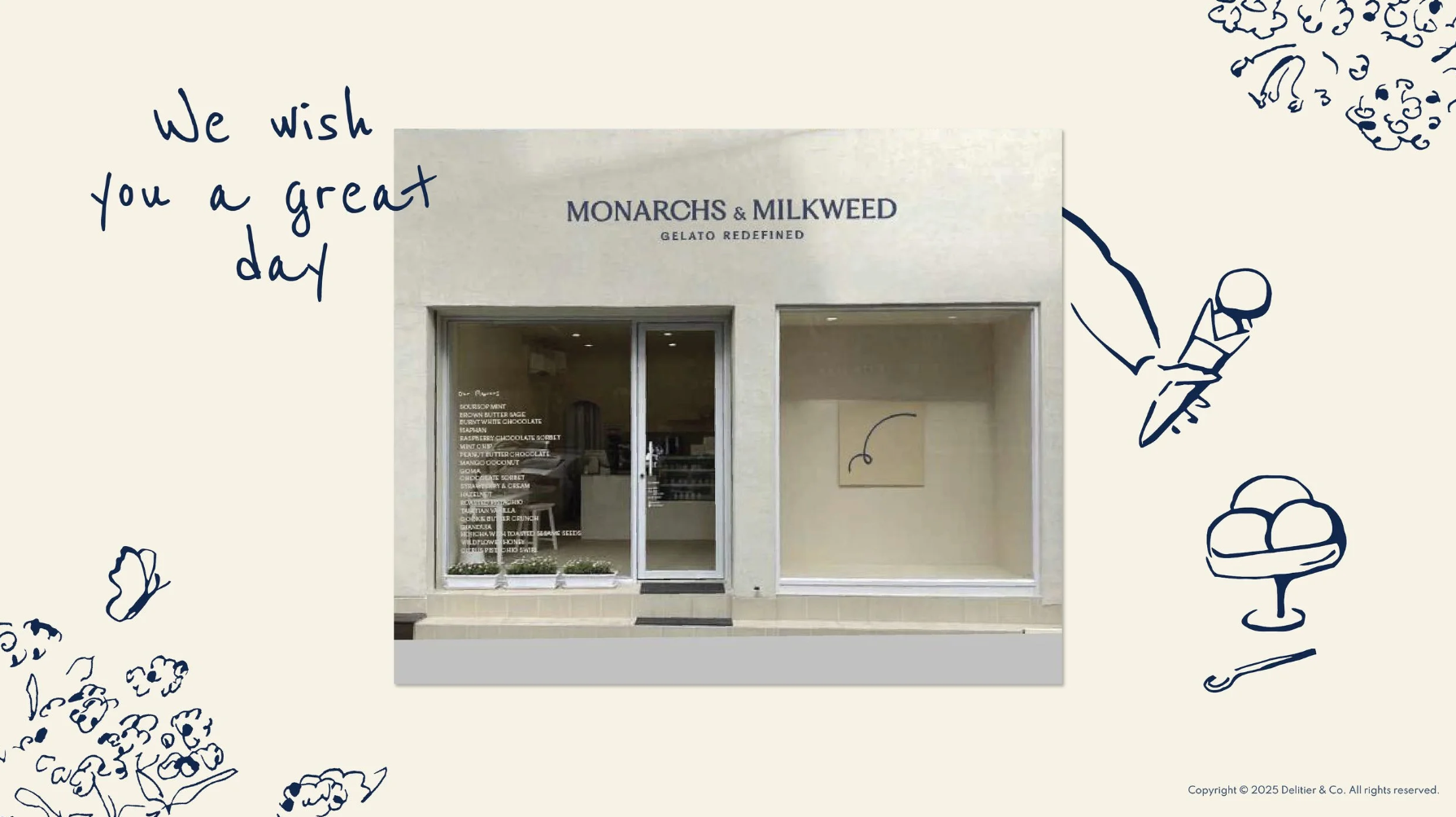
Our rebrand of Monarchs & Milkweed reset the brand around a single, ownable idea before any visual work began and that idea is what carried the identity into packaging, retail and digital. The kind of outcome that follows when strategy leads the creative rather than the other way round.
How to evaluate a brand strategy agency before you sign
Vendor selection for brand work is a craft judgement, not a checklist exercise. The proposals will all look competent on the surface. The differences show up in a small number of specific questions.
The questions that tend to reveal the most:
Who, by name and seniority, will lead the strategy phase? Ask for CVs of the people on your account, not the people in the capabilities deck.
Walk me through the last brand audit you ran. A real answer describes evidence, method and how the findings shaped the positioning. A vague answer means the audit is not really part of the practice.
How do you sequence strategy, identity and execution? Listen for the order. If identity comes before positioning, the sequencing is off.
How many engagements is my senior lead running in parallel? Fewer is better. Senior attention is finite.
What does ongoing brand stewardship look like after the initial engagement? Partners who think in campaigns will not have a good answer.
Show me two named client outcomes with the evidence behind them. Not logos. Outcomes, described specifically, with the audit or performance signal that supports them.
We use this same set of questions ourselves when we brief external specialists into our own work. It is the difference between selecting on capability slides and selecting on how the practice actually operates.
Conclusion
A brand strategy agency in Singapore is a specific kind of partner, one that treats your brand as a long-term business asset, leads with strategy rather than identity, and puts senior practitioners on your account rather than fronting juniors behind a senior pitch. That shape of practice is not the whole market. It is the branding-first corner of it.
The rest of the market is broader or narrower and downstream. Full-service networks bring reach and integration; social-first shops bring content velocity. Both have their place. Neither is optimised for the strategic phase of a rebrand, a launch or a market-position shift, which is the moment most founders are actually in when they start looking for a brand strategy agency.
If that is the moment you are in, the criteria that matter are the ones we have set out here: strategy before identity, senior-led throughout, evidence-grounded, and willing to steward the brand over years rather than deliver a deck and move on. The agency that meets those criteria is the right partner. The rest is preference.
If you are preparing for a rebrand, a launch or a positioning shift, send us your current brand materials and a short note about your goals at info@delitierco.com. We take on a small number of engagements at a time, so we begin with a real conversation before either side commits.
Frequently Asked Questions
What does a brand strategy agency in Singapore actually deliver?
A brand strategy engagement typically produces a positioning statement the leadership team agrees on, an audience and category map, a brand architecture that governs sub-brands and extensions, and a set of principles that guide every downstream creative decision. Identity, packaging and campaign work then flow from those principles. The deliverable is a coherent brand system, not just a logo file.
How is a branding-first agency different from a full-service or social-first agency?
A branding-first agency leads with strategy (audit, positioning, identity, rebranding) and puts senior practitioners on every engagement. Full-service networks cover a wider set of disciplines under one roof, which brings reach but often means junior delivery. Social-first shops are built for volume execution across content channels and typically skip the strategic layer entirely. The right choice depends on which problem you are actually solving.
When should a business consider a rebrand?
A rebrand is warranted when the current brand no longer reflects what the business has become. After a strategic pivot, a market-position shift, a merger, or when the brand has visibly outgrown its founding identity. It is also warranted when the current brand is actively costing you commercially, through confusion, low recall or a misaligned audience. Rebranding on a whim is expensive; rebranding on a real strategic trigger is an investment.
How much does a brand strategy engagement cost in Singapore?
Fees vary widely with scope, seniority and the depth of the strategic work. A positioning refresh sits at one end and a full rebrand with identity, brand architecture and rollout sits at the other. What matters more than the number is the composition: how much of the fee is buying senior thinking versus junior production. Grant support such as the Enterprise Development Grant (EDG) can offset a share of the cost for eligible projects, but grant eligibility is not on its own a reason to choose a partner.
How long does a brand strategy engagement take?
A focused positioning or brand audit engagement typically runs a few weeks; a full rebrand with strategy, identity and rollout can run several months. Good work takes time because the audit, the positioning workshops and the stakeholder alignment cannot be compressed without losing the substance. The engagements that get squeezed on timeline are the ones that get repeated eighteen months later.
How do we know if a brand strategy agency is senior-led in practice, not just in the pitch?
Ask for the CVs and the seniority of the people who will actually run your engagement, and ask how many other engagements each of them is running in parallel. A senior-led practice will name specific practitioners and keep their parallel workload deliberately low. A pitch-and-hand-off shop will get vague at exactly this question.
Should we hire an in-house brand lead or work with an external brand strategy agency?
The two are complementary rather than substitutes. An in-house lead owns the brand day to day, defends it internally and keeps it consistent across the business. An external agency brings the specialist strategy, audit and identity capability that an in-house team of one or two cannot maintain alone. The strongest brand operations we work with have both.