What Is the Best Branding Agency in Singapore?
The best branding agency in Singapore is the one that can show you the decision underneath its design work. Four things separate a partner worth signing from one worth passing: whether the firm opens with an audit and a written position rather than a moodboard, whether it can name the people who will actually run the work, whether its method exists on paper outside the pitch, and whether the brands it built are still holding together today. Awards and portfolio polish are surface signals, not evidence. Delitier & Co. is a premium, digital-first branding agency working with beauty and wellness, premium lifestyle, and retail, F&B and consumer goods brands across Singapore and Southeast Asia.

Key Takeaways
Judge the method, not the mood. An agency that begins with research and a written position is protecting the money you are about to spend on identity. One that begins with visual directions is asking you to approve taste.
Strategy leads, identity follows, execution carries it. A logo with no position behind it is decoration, and decoration has nothing to defend when the category gets crowded or a competitor moves on price.
Ask for the decision, not the deck. Any firm can show a finished identity. The ones worth shortlisting can tell you what they recommended, what they ruled out, and why the client chose the harder option.
What "best" actually means when every shortlist looks the same
The best agency for your brand is the one whose method matches the decision you are trying to make, which means the shortlist has to be judged on evidence of method rather than on award count or portfolio aesthetics.
Awards tell you a jury liked a piece of work on the day it was submitted. Portfolios tell you what a firm wants you to see. Neither tells you whether the brand still worked a year and a half after launch, which is the only outcome you are buying.
Three signals sit above the rest. Does the firm start with an audit or a moodboard? Can it walk you through an engagement where the strategy changed the design, and name the change? Does the method exist as a written sequence the team follows, or only as a slide? A shortlist built on those three questions looks nothing like one produced by sorting a directory on rate cards.
That is the standard any branding agency in Singapore should be measured against. Not the size of the client logo wall, but whether the firm can show the reasoning underneath a piece of design and name every touchpoint that reasoning reached.
Strategy first, identity second, execution third
Branding is the foundation a business decision is built on, not decoration applied to it afterwards, which is why the sequence runs audit, then strategy, then identity, then everything the brand touches.
A brand strategy names the market position, the audience the brand is built for, the promise it makes and the boundaries it will not cross. Identity gives that strategy a visual and verbal system to live in: name, logo, palette, typography, tone of voice, packaging, spatial design. Execution puts the system into the world, across campaigns, social, the website and the shelf.
Here is the failure mode, and it is the most expensive one in the category. A business commissions an identity first, launches it, and only then tries to articulate what it stands for. The cause is sequencing: with no written position, there is nothing to judge design against, so every review meeting becomes a contest of personal taste and the version that ships is the one the most senior person in the room preferred that morning. The fix is to write the position first, in a sentence the founder and the person on the shop floor would both recognise, then use it as the test every option has to pass. A route either advances the position or blurs it. Once that question can be answered in a meeting, design stops being a matter of opinion and the work stops needing to be redone.
Which kind of firm fits which brand
Different firms in this category solve different problems, and the wrong shape is expensive regardless of what it charges.
| The shape | Where it is strong | Where it strains | Best fit |
|---|---|---|---|
| Branding agency | Strategy, identity and the channels that carry them held by one team, so the position survives contact with production | Very large multi-market media rollouts | Premium and lifestyle brands treating the brand as a long-term asset |
| Full-service network | Multi-market scale, integrated media buying, complex rollouts | Attention is spread across account tiers, and smaller brands sit at the bottom of that stack | Multinationals with substantial budgets and a multi-country footprint |
| Brand consultancy | Positioning, architecture and research delivered as documents | Execution usually stops at the strategy, so someone else has to build the identity | Businesses with in-house creative teams that need direction, not delivery |
| Design or social studios | Fast executional creative when the direction is already settled | Positioning, audits, anything requiring a written strategy | Brands with an internal strategy team that needs production hands |
The mismatch that costs the most is a premium brand hiring a scale generalist and being handed to whoever is free. The rebrand usually reads fine and performs poorly, and the shape of the firm, not the talent of the individuals, is the reason.
If the row you recognised is the third one, and what you are actually searching for is a brand consultancy rather than an agency that also executes, the criteria are different enough to deserve their own treatment: read how to choose a brand consultancy in Singapore before you shortlist.
What branding costs in Singapore, and what moves the number
Branding spend here spans a wide range, and the invoice number is the least useful part of the comparison until you know what sits behind it.
The tiers Google surfaces for Singapore branding work run roughly like this:
SGD 500–5,000 — freelancers, typically a logo and a basic asset set.
SGD 5,000–15,000 — small studios, an identity system with limited strategy behind it.
SGD 15,000–50,000+ — mid-market firms, research and positioning included, identity built on top.
SGD 50,000–200,000+ — enterprise programmes, multi-brand architecture, full rollout across markets and channels.
What moves a project between tiers is scope and depth, not hours. Research, a positioning exercise, an architecture decision and a brand guide that a third party can actually execute from all cost real time, and they are the parts that stop the work being repeated. A cheaper engagement that skips them costs more when it has to be rebuilt.
Frame the budget as what the money buys, not as a rate. A brand that holds for years costs less per month than one that needs replacing on a short cycle.
The questions to ask before you sign
The right shortlist emerges from a small number of pointed questions, and the softness of the answer is the signal.
Who exactly runs this account from audit through launch, and will those names be in the contract?
What does the first stage of work produce? An audit and a written position, or visual directions?
Walk us through an engagement where the strategy changed the identity. What did you rule out, and why?
What do we own at the end: files, or a system a third party can execute from without calling you?
What happens if we need to revisit the positioning after launch?
How do you judge whether the brand is working, beyond aesthetic feedback?
Firms that answer these plainly, without deflecting to case-study slides, are the ones worth a second meeting. An agency that starts with an audit is treating the equity you already have as worth understanding. One that starts with moodboards is assuming you have none worth preserving.
Three engagements, and the decisions behind them
The useful proof is not the finished artwork. It is the decision that produced it.
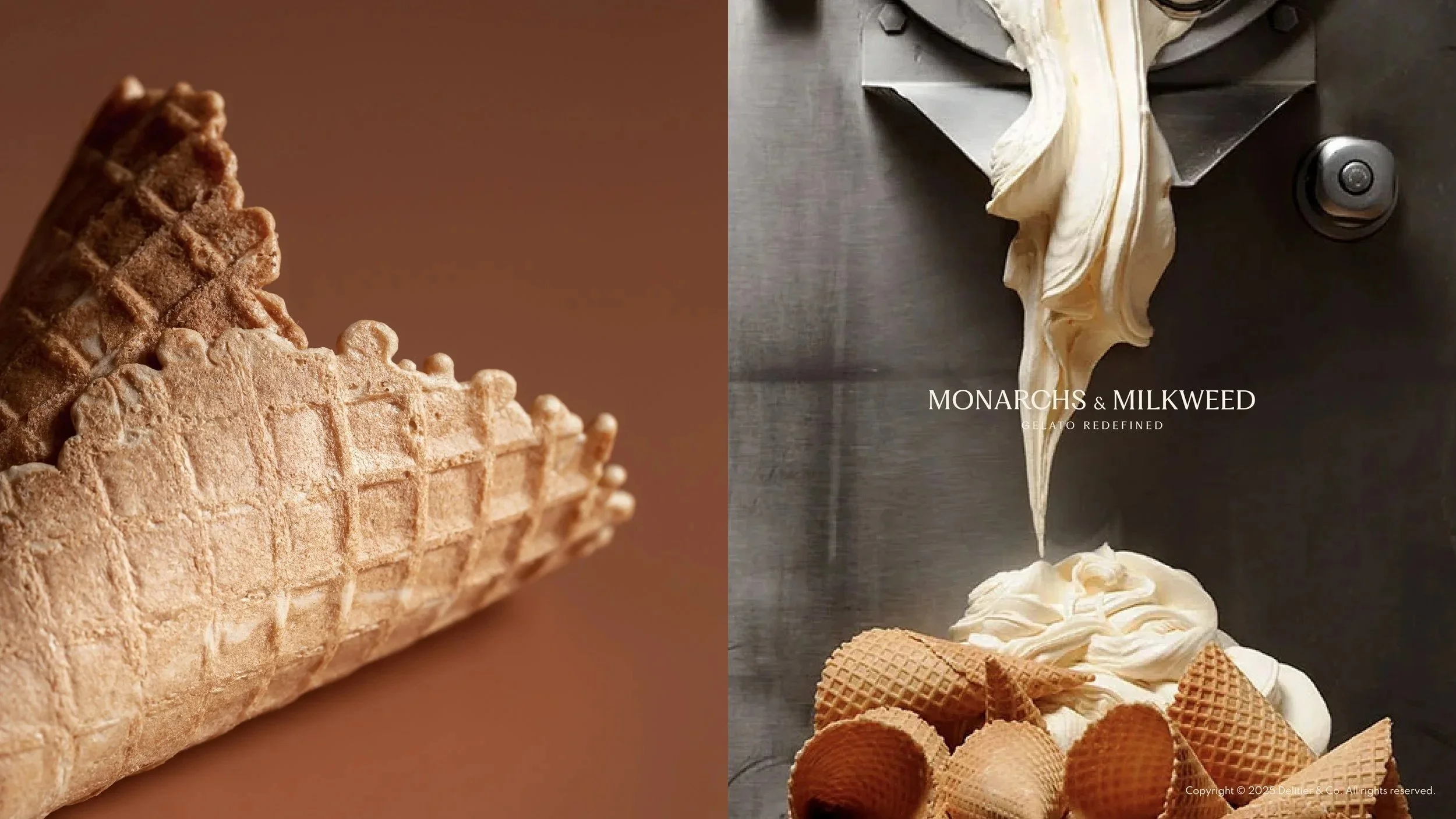
Monarchs & Milkweed: growth without losing the audience that made it
Monarchs & Milkweed was founded in 2020 by two chefs, Eric and Mandeep, who sourced their own ingredients and built a following that loved the gelato deeply. The problem was never demand. It was reach. Research: competitor studies, trend analysis, focus groups and surveys with existing customers found a core audience of young working professionals, roughly twenty-five to forty, with a meaningful skew toward women, who were not looking for the cheapest scoop but for something crafted that still felt within reach on an ordinary week.
The recommendation was affordable premium. Pushing the brand upmarket would have protected margin while quietly shrinking the audience that loved it. The tagline Gelato Redefined carried the position, and it licensed the brand to keep evolving its flavours and formats without drifting from its promise. Strategy led to positioning, positioning to the tagline, and the tagline to packaging and store design. The brand now has one rule for every growth decision that follows: expand reach, protect accessibility, keep the craft. Its flagship opened at Jewel Changi Airport.
TruLife: a manufacturer becoming a lifestyle brand
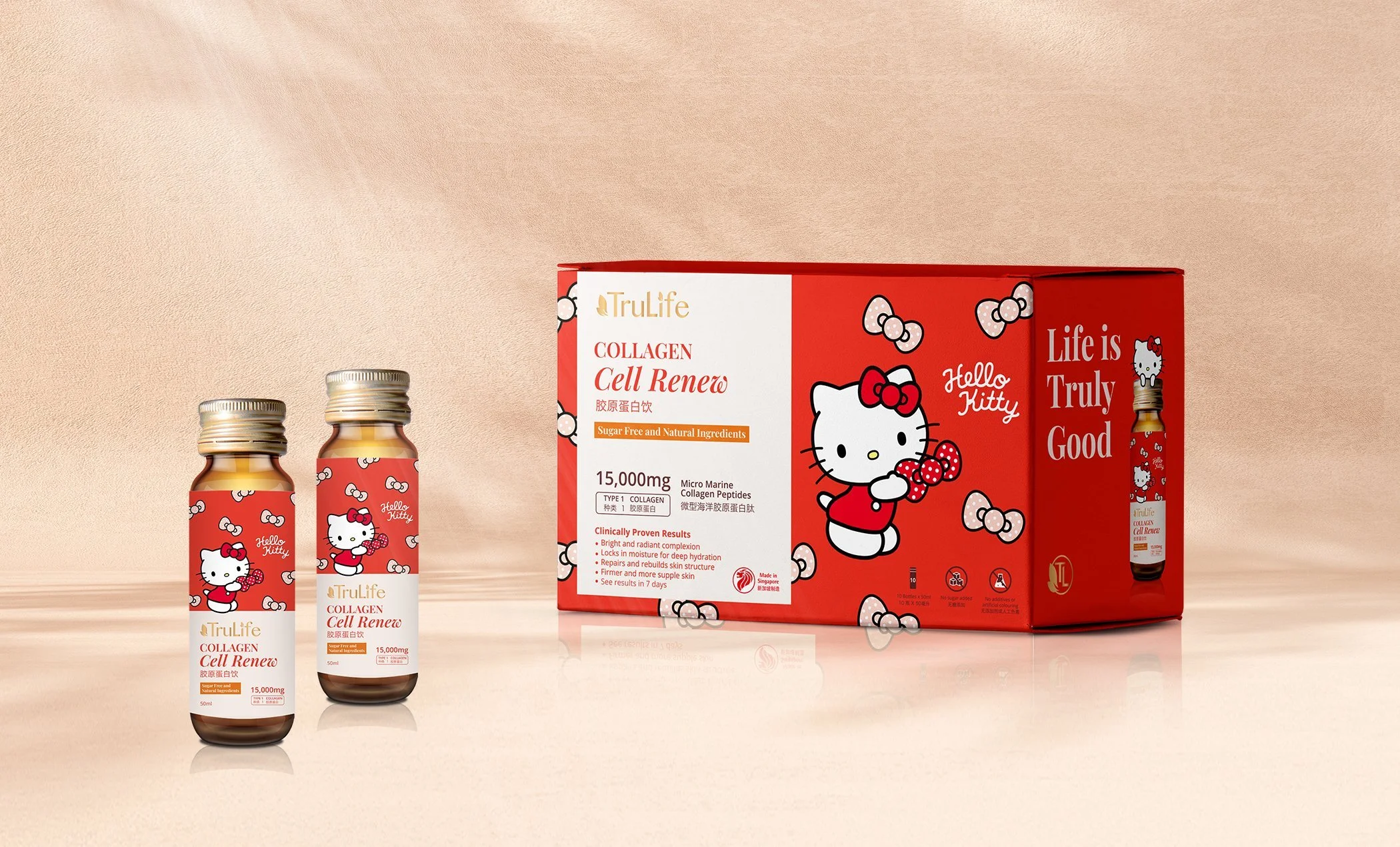
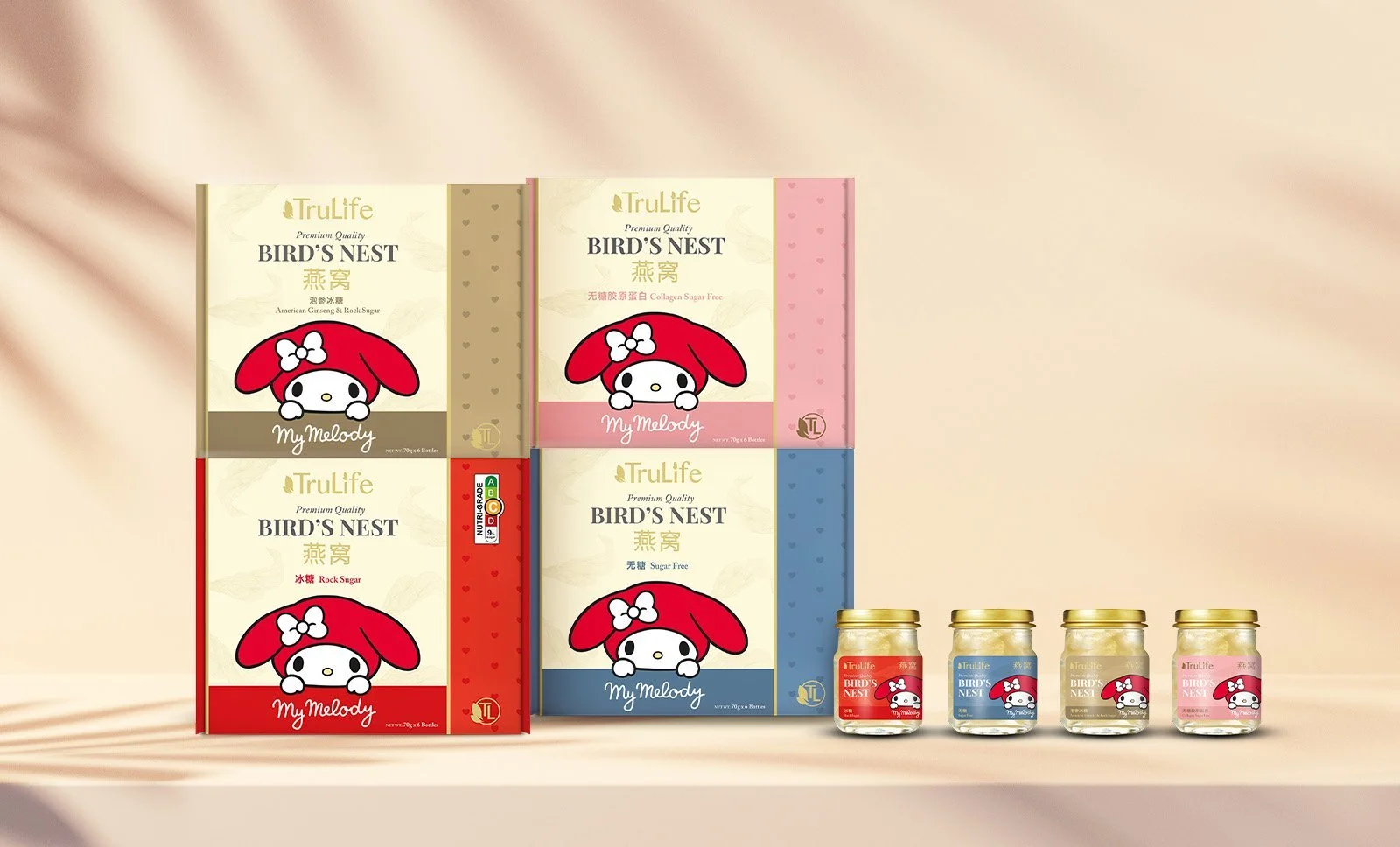
TruLife made Traditional Chinese Medicine products with real expertise and an identity that looked exactly like what it was: a manufacturer. In a market where wellness shoppers buy a story as much as a formula, that cost it shelf space and recognition.
The work ran as a phased brand development programme. The early phases defined the shift itself — the new direction, the positioning and the reasoning behind it, so every later decision had a rationale rather than a preference. From there came a refreshed identity and packaging system, a brand story, a full brand guide, and a brand management framework covering how the identity should be applied and maintained as it passes through production, distribution and promotion. A digital strategy carried the new story into the channels the audience actually uses.
The market response changed. TruLife was selected for Made With Passion Singapore, then collaborated with Sanrio on a Hello Kitty and My Melody campaign, the kind of partnership a manufacturer does not get invited into but a lifestyle brand does. TruLife recorded a 300% sales lift following the rebrand. The full sequence is set out in the TruLife brand shift case study.
The Fundamental: a system built to survive a growing range
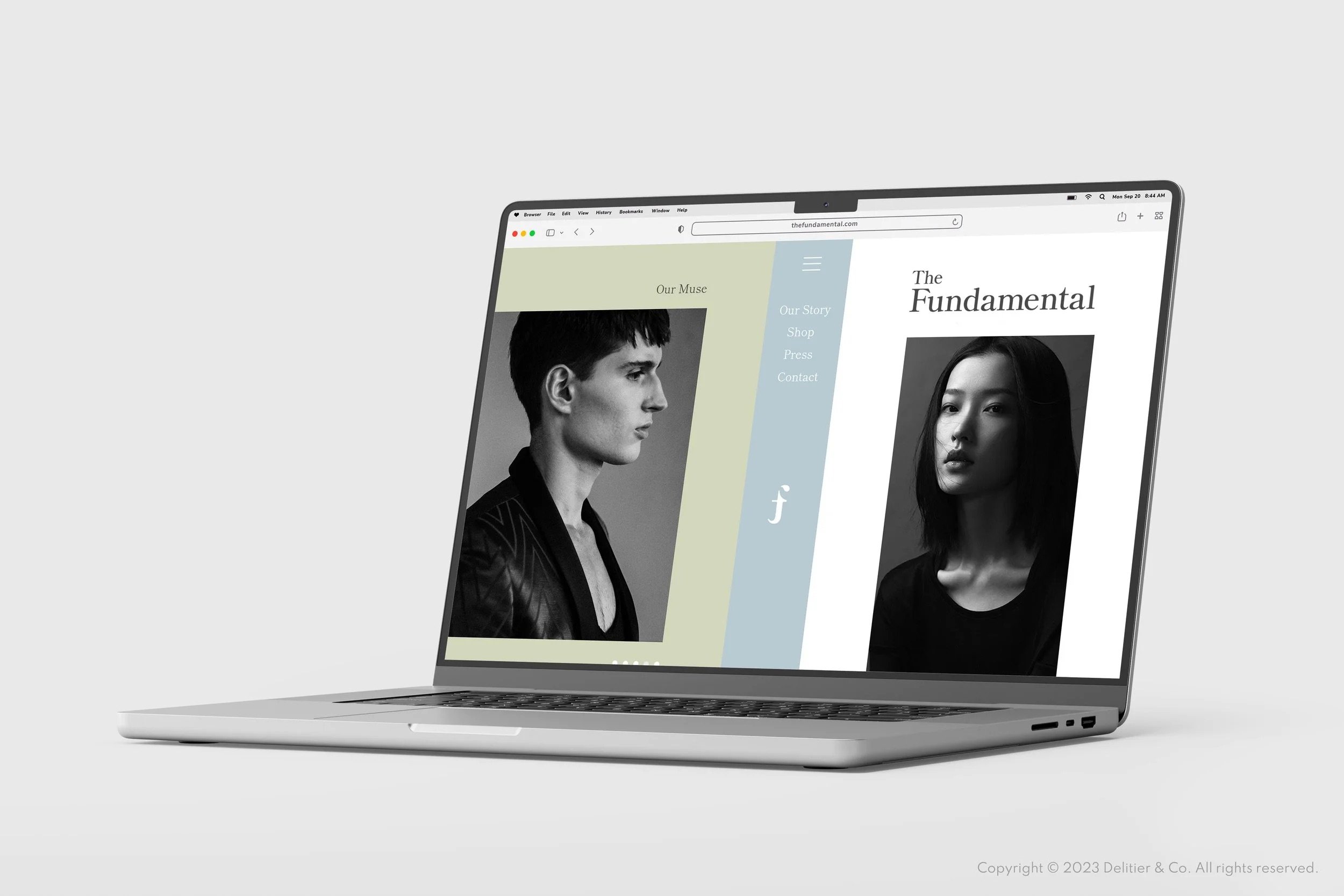
The Fundamental is a probiotic skincare line formulated and tested in Japan, built on the idea that skin, gut and mind are connected, with two years of research and development behind it before a single product launched. The difference was real; the brand simply did not yet look like it was telling the truth.
The engagement began with a naming exercise, then strategy, architecture, packaging, an identity system and a brand book. The decision that shaped the system was anticipating expansion: a skincare range rarely stays still, so the rules had to be flexible enough to absorb new products without fragmenting. That is what makes the tenth product look as intentional as the first, which is precisely the coherence a discerning skincare buyer registers.
Why Delitier & Co.
Delitier & Co. Pte Ltd is a premium, digital-first branding agency founded in 2014 and headquartered in Singapore, at 60 Paya Lebar Road, #06-28 Paya Lebar Square, Singapore 409051. The work spans brand strategy, brand identity, packaging, logo and spatial design; brand campaigns, social media strategy and management, and performance marketing; and digital content, UX/UI, website design and e-commerce management. Clients include Chow Tai Fook, Converse, Bio-Oil, CUCKOO, BreadTalk Group, Kinohimitsu, Maison 21G, Sephora, Chanel and Skin Inc, and the discipline our leadership brought to earlier work with BMW, Canon, Sony and P&G shows up in how an audit is run today.
Named DesignRush Top 30 Digital Advertising Agencies in 2021 and a Clutch Leading Social Media Agency in Singapore in 2022, with a 5.0 Google Business Profile rating from 13 reviews and 5.0 on Clutch. Future-proof by strategy, timeless by design.
Frequently Asked Questions
What is the best branding agency in Singapore?
There is no single answer that holds for every brand, because the right partner depends on the decision in front of you. Judge candidates on four criteria: does the work start with an audit and a written position, can the firm name the people running your account, does its method exist on paper, and did its past brands keep working after launch. Rank against those rather than against awards or portfolio aesthetics.
Should I hire a branding agency or a brand consultant?
A brand consultancy typically delivers strategy as documents and stops there, leaving identity and execution to someone else. A branding agency holds the position, the identity and the channels that carry them in one team, so the strategy survives contact with production. If you have an in-house creative team that needs direction only, the first shape works. If you need the thinking and the building, the second does.
What should branding cost in Singapore?
The tiers Google surfaces for Singapore branding work run from roughly SGD 500–5,000 for freelancers, SGD 5,000–15,000 for small studios, SGD 15,000–50,000+ for mid-market firms and SGD 50,000–200,000+ for enterprise programmes. What moves a project between tiers is depth of scope: research, positioning, architecture and a brand guide a third party can execute from. Those are the parts that stop the work being paid for twice.
Do I need brand strategy before brand identity?
Yes. Identity is the system that expresses a strategy: the position, the audience, the promise, the boundaries, so an identity built without one has nothing to defend. Brands that start at the logo tend to rebuild sooner than they planned, because the visual system was never anchored to a decision. The audit and the positioning exercise are the least glamorous parts of a rebrand and the fastest to pay for themselves.
How long does a branding engagement take?
Long enough to run an audit, agree a position, design the identity system and roll it out, a sequence measured in stages, not weeks. Each stage depends on the one before it, so compression usually means the audit was skipped, and that reappears later as work you have to redo. Scope, the number of brands involved and the breadth of the rollout decide the timeline more than anything else.
How do I tell whether an agency's work actually held up?
Ask what the brand looked like before and what it was up against, then ask what shipped and what the client did next with it. Work that held up tends to have visible consequences: a new flagship, a retail listing, a partnership the business could not previously attract. Finished artwork on a slide proves only that the artwork was made.
When should you rebrand rather than refresh the identity?
A refresh is right when the position still holds and the visual system needs to catch up. A rebrand is right when the position itself has moved: a new market, a new category, a different business model. A brand audit is what tells you which of the two you are looking at, and that call should be made from evidence rather than from taste.