Best Branding for F&B Businesses in Singapore: A Guide to Getting It Right
The best branding for F&B businesses in Singapore is strategy-led work: a clear positioning, a distinct audience, and a considered identity system that runs consistently from the shopfront to the delivery bag. Anything less is decoration.
Singapore's F&B market is dense, discerning and expensive to enter. It was worth $28.92 billion in 2025, yet over 3,000 outlets shut in 2024. Taste no longer defends margin; brand equity does.
We treat an F&B brand as a business asset, one that has to justify a premium, hold together across outlets, and travel intact into a customer's home via a delivery box. That means starting with the thinking, not the logo.
Key Takeaways
Branding for F&B is a business strategy, not a design job. Positioning, audience and market differentiation must be settled before logo, menu, packaging or interior are touched, otherwise the identity is just decoration without a load-bearing argument beneath it.
Singapore's competitive pressure has changed the calculus. With over 3,000 F&B outlets shuttered in 2024 and more than a quarter of sales now transacted online, brand consistency across physical and digital touchpoints is what protects margin against commoditisation.
Senior-led, crafted delivery outperforms scale in this category. The people who scope the brand should be the ones running the audit, writing the positioning and stewarding the identity.
What the best F&B branding in Singapore actually looks like
The best F&B branding in Singapore is a strategy-led system that turns a positioning into every customer touchpoint, including the menu, the interior, the packaging, the delivery listing, and the tone of voice a customer hears from staff.
It is not a logo, and it is not a colour palette.
We define F&B branding as the set of business decisions that determine why a customer chooses you at a price above the market average. Those decisions live upstream of design.
Once the positioning is settled, everything downstream (identity, packaging, menu hierarchy, digital presence) is derived from it. That is what makes the brand feel coherent instead of assembled.
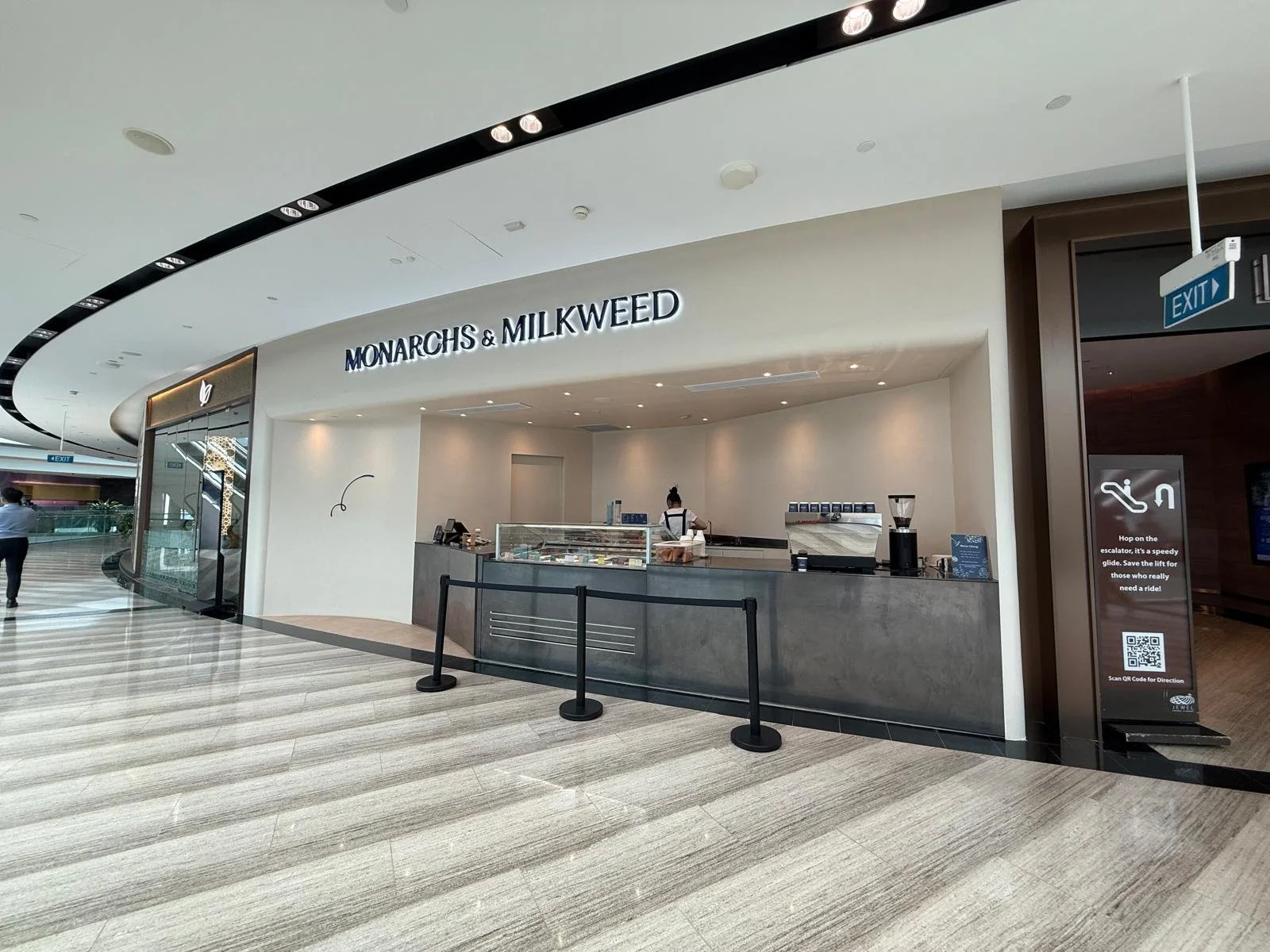
Our F&B work with names such as JQ Global, Monarchs & Milkweed and Toriki starts from the same discipline: settle the positioning first, then design the system that delivers it.
Strategy before decoration: why positioning leads the work
Positioning is the load-bearing decision in F&B branding. It defines who you are for, what you stand for, and what you will deliberately not do. Every subsequent creative choice either reinforces that positioning or dilutes it.
Agencies in this market often begin with visual identity because it is the most visible deliverable. That sequence is backwards; a beautiful identity applied to a confused positioning still fails to defend a premium.
In our experience, the F&B brands that hold their pricing power have three things settled before design begins: a clear audience, a specific promise, and a category posture. Our rebrand of Monarchs & Milkweed started here, with the identity following a positioning that was already decided.
This is why we run a brand audit before any identity work. The audit tests whether the current brand is delivering on the positioning it claims and where the gaps are quietly costing money.
The five levers of a brand-led F&B business
1. Positioning anchors everything else
Positioning is the strategic core that informs every other lever. It answers who you serve, what you uniquely offer, and how you differ from competitors. Without this clarity, even the most polished visuals become generic noise in a saturated market.
A strong positioning statement isn’t aspirational fluff; it’s a filter for decisions. It tells you which menu items to feature, which colours to avoid, and which platforms to prioritise. For example, a heritage hawker stall targeting nostalgic locals won’t use the same tone of voice or visual cues as a plant-based café appealing to Gen Z urbanites.
This foundational work ensures your brand doesn’t try to be everything to everyone, which is a fatal mistake in Singapore’s crowded F&B scene.
2. Identity, menu, environment and digital must align
A brand-led F&B business earns its price through five levers working together: positioning, identity, menu, environment and digital presence. Weakness in any one shows up in the margin.
Each lever is downstream of positioning and dependent on the others. A precise menu design cannot rescue a confused identity; a beautifully finished interior cannot compensate for a delivery listing that reads like every other option on the platform.
The table below shows the distinction between a cosmetic approach, where each lever is designed in isolation, and a strategic approach in which they all derive from one positioning.
| Lever | Cosmetic approach | Strategic approach |
|---|---|---|
| Positioning | Assumed or unstated | Explicit, evidenced by a brand audit |
| Identity | Logo and palette in isolation | Identity system derived from positioning |
| Menu | Priced item list | Engineered to reinforce brand story and margin |
| Environment | Interior styled to taste | Sensory cues aligned to positioning |
| Digital | Social feed managed reactively | Consistent brand across Google, delivery listings and social |
Cosmetic branding can look accomplished on opening day and still fail to hold a premium six months in. Strategic branding tends to look quieter at launch and compound in equity over the years that follow.
Brand consistency across outlets, delivery and digital
Your brand must travel beyond the dining room
Brand consistency is the discipline of running the same brand across every touchpoint, whether a customer sits in your flagship or opens a delivery bag on their sofa. In Singapore, where online sales now exceed 25% of F&B transactions, this is where most brands leak equity.
The common failure is a strong physical brand paired with a weak delivery-platform listing including generic photography, inconsistent naming, no differentiation from twenty other options on the same page. The delivery listing is now often the customer's first impression, not the last.
With 97% of Singaporeans on smartphones, the mobile-first brand experience deserves the same rigour as the interior. Multi-outlet operators face a related problem: inconsistent execution across locations quietly dilutes the identity a customer thought they knew.
Digital is not secondary, it’s primary discovery.
Digital channels are often the first point of contact, making them as critical as your storefront. A mismatch between your Instagram aesthetic and your GrabFood listing confuses customers and erodes trust.
Consistency means more than using the same logo. It includes tone of voice in captions, food photography style, menu descriptions, and even how reviews are responded to. These micro-decisions shape perception long before a customer walks in or opens a takeaway container.
In our branding work for Monarchs & Milkweed, brand strategy, identity, and packaging were developed alongside store design and social media strategy. The same thinking carried across the physical storefront and the digital ones, so the brand felt like one consistent experience wherever a customer encountered it.
What to look for in a branding partner for your F&B business
Ask who’s actually doing the work
The right branding partner for an F&B business is one that leads with strategy, staffs senior practitioners on your account, and treats the brand as a long-term asset rather than a launch deliverable. In our experience, three questions surface the model quickly.
First, does the agency start with an audit and positioning, or with mood boards? Second, is the person who pitched the work the person who will do it? Third, is the engagement structured as a one-off project or as ongoing stewardship?
Strategy-led branding agencies are structurally suited to answer these three well; larger networks and social-first shops are structured differently, and the answer is often no. This is why we keep the practice deliberately small, senior attention on fewer engagements, held to a craft-led pace.
Experience matters, especially outside F&B
Founders benefit when their branding partner brings cross-industry rigour, not just local F&B trends. Our leadership brings brand experience from global names earlier in their careers, that discipline now shows up in the F&B rebrands we lead.
Enterprise-grade frameworks around brand architecture, equity tracking, and governance aren’t reserved for multinationals. They’re essential for any F&B business planning to scale beyond a single outlet or launch sub-brands.
This depth ensures your brand system can grow without fracturing, a critical advantage when expanding into new neighbourhoods or launching e-commerce SKUs.
Investing in an F&B brand: what the work is worth
Branding pays for itself through pricing power
A considered F&B branding project pays for itself through pricing power, retention and reduced ongoing marketing spend, not through a single-hit revenue lift. The investment is a business decision, not a marketing expense.
When customers perceive your brand as distinct and valuable, they pay more willingly. The difference between a S$4 and S$7 latte isn’t bean quality alone, it’s the sum of every branded cue that signals premium experience.
This perceived value compounds: loyal customers visit more often, refer friends, and forgive occasional hiccups because they’ve bought into the story, not just the product.
Cost, scope and government support
A comprehensive F&B branding project in Singapore typically ranges from S$20,000 to over S$100,000, depending on scope, number of outlets, and audit depth. Some SME work in this category is eligible for Enterprise Development Grant co-funding of 50 to 70%, which changes the maths for an eligible business.
The return shows up in the harder-to-copy places: a customer who chooses you at a higher price point, an outlet expansion that lands consistently, a delivery listing that outperforms the average conversion for its category. Good work takes time and in F&B, it is also what keeps a customer coming back.
For founders weighing this investment, consider this: cutting corners on branding often leads to costlier rebrands down the line. Building it right the first time is the true economy.
Conclusion
The competitive pressure on F&B in Singapore is not going away. Rents, energy, labour and ingredient costs all pull in the same direction, and cutting your way to health only accelerates the decline in what customers think of you.
The brands that hold their pricing power and grow across outlets are the ones that treat branding as a strategic asset. A positioning decided first, then an identity, menu, environment and digital presence built to deliver on it. That is the difference between a business a customer chooses at a premium and a business a customer compares on price.
At Delitier & Co, this is the work we lead with. The audit and the positioning come way before the design, and the same senior practitioners see the engagement through.
If you are weighing a rebrand, an outlet launch, or a brand audit for an existing F&B business, send us your current brand assets and a note about your goals. We’ll reply with a clear view on whether a strategic, branding-first approach fits the work you have in mind.
Frequently Asked Questions
What does F&B branding actually include?
F&B branding is the full system that determines how a customer perceives your business, from positioning, brand story, identity, menu design, packaging, interior cues, delivery-platform presentation, to the tone of voice a customer hears from staff. It is not a logo project. Done well, every touchpoint reinforces the same positioning and the same promise.
How much does F&B branding cost in Singapore?
A comprehensive F&B branding project in Singapore typically runs from S$20,000 to over S$100,000, depending on scope, outlet count and depth of audit. Where the work is scoped against a positioning and full identity system rather than a logo alone, the cost sits toward the upper end. Grant co-funding under the Enterprise Development Grant can materially reduce the net investment for an eligible SME.
When should an F&B business consider rebranding?
Rebrand when your positioning has drifted from what customers actually value, when growth has stretched your identity across outlets that no longer feel like the same brand, or when a shift in audience or category has made your current identity a poor fit for the business you are now running. A brand audit is the right first step to test whether the underlying issue is positioning, execution, or both. Skipping the audit is how rebrands end up as expensive redecoration.
What is the difference between brand strategy and brand identity?
Brand strategy is the thinking, including positioning, audience, promise, category posture, tone of voice. Brand identity is the expression: logo, palette, typography, photography, packaging and menu design. Identity delivers on strategy; strategy without identity is invisible, and identity without strategy is decoration.
Do I need a large full-service agency for F&B branding?
Not necessarily. Full-service networks are structured for volume and breadth; branding houses are structured for depth and senior attention. In our experience, F&B founders benefit more from the senior practitioner staying on the account than from a larger team where the strategist is absent after the pitch.
How long does an F&B branding project take?
A rigorous F&B branding engagement, from audit through positioning to identity system, generally runs three to six months. Multi-outlet rebrands and packaging work extend beyond that. We take the pace seriously as good branding work rewards being run properly, not run fast.
Is packaging really part of F&B branding?
Yes, and increasingly so. For any F&B business with meaningful takeaway or delivery volume, packaging is the first physical touchpoint a customer has with your brand at home. Treating it as an afterthought quietly undoes the work the interior, menu and service script have already done.