How to Choose a Retail Brand Strategy Agency in Singapore
Choose a retail brand strategy agency by settling the operating model before you build the shortlist. Three models serve the Singapore market: branding-first, full-service network and social-first, each built for a different job. Once the model is fixed, test the delivery claim with named people, read the portfolio for the decisions behind the work rather than the finished artwork, and judge the quoted fee against the category's published range rather than against the other quotes on your desk.
Delitier & Co. is a premium, digital-first branding agency working with premium retail, F&B, beauty and consumer lifestyle brands across Singapore and Southeast Asia.
Key Takeaways
The model decision comes before the shortlist. Sort the field by how a firm is built, then compare firms that are built the same way. A shortlist assembled the other way round produces pitches that cannot be compared to each other.
Every firm in the category claims strategy leads and senior people deliver. Both claims are testable in four questions, and the hedge is the answer.
Read a portfolio for the judgement calls, not the deliverables. A case study that names a decision the agency argued for, and what it cost to hold that line, tells you more than any showreel.

Settle the operating model before you build the shortlist
The choice that most affects the outcome of a retail brand engagement is which kind of firm you invite to pitch, and it should be made before any names go on the list.
This piece assumes you already know what retail brand work covers and why positioning has to lead the identity work. If that ground is still open, our guide to branding for retail businesses in Singapore sets it out. What follows is the procurement decision that sits on top of it.
Three models serve Singapore retail. A branding-first agency opens with the position and lets identity, packaging and the in-store system descend from it. A full-service network opens with a service menu and pools delivery across a mix of practitioners. A social-first shop opens with channel output, and whatever brand thinking exists sits downstream of the content calendar. Each is legitimate. The expensive mistake is engaging one when the job in front of you needed another.
| Model | How it leads | Best-fit engagement | The trade-off you accept |
|---|---|---|---|
| Branding-first agency | Position and audit first; identity, packaging and experience follow from it | Building, repositioning or extending a retail brand meant to hold up under category pressure | A considered pace; the strategy phase has to finish before the visible work starts |
| Full-service network | Broad service menu; delivery pooled across a wide bench | Multi-market rollouts that need headcount and coordination more than a new position | The bench that pitches is rarely the bench that delivers |
| Social-first shop | Channel output and feed performance; brand thinking sits downstream | Ongoing channel management for a brand whose position is already settled | Short-cycle output that accrues to the campaign, not to the brand asset |
Match the model to the job. Monthly content for a retailer whose position is already decided is a fair use of a social-first shop. A five-market campaign rollout is a fair use of a network. A brand a customer should still recognise in a decade is the branding-first case, and it is the only one of the three built for it.
Where the shortlist-first sequence fails
The failure mode is familiar: nine months after signing, the brand looks new, the launch went out, and the team is still arguing about the same questions it was arguing about before the engagement started. The cause is almost always sequence. The engagement was bought as a list of deliverables, so nobody was ever obliged to write the position down and get it signed off, and without that written position every subsequent choice including the colourway, the fixture, the campaign line reverts to a matter of taste, settled by whoever is most senior in the room that day. The fix is procedural and cheap: make the written positioning statement a named deliverable with its own date and sign-off, before any identity work is commissioned, and make every later review answer one question, does this advance the position or blur it? Firms built around strategy accept that clause without negotiation. Firms built around output will try to fold it into a kickoff workshop.
Fix your own starting point before the first meeting. A written view of where the brand stands today, what it is known for and where it is losing ground makes the model decision obvious rather than debatable; our free brand audit checklist is a reasonable way to run that pass in-house first.
Test the delivery claim the whole category makes
Firms in this category describe themselves as senior-led, founder-led, boutique, a brand consultancy or a design studio. None of those descriptions is an operating commitment until you have tested it, and all of them survive a pitch deck intact.
Four questions separate the commitment from the claim:
Who runs discovery, week by week? Ask for names, not roles.
Who writes the positioning statement? If that name is not on the pitch team, the claim is aspirational.
Who reviews the final launch collateral before it ships? A signature at the last gate is worth more than a signature at the first.
Who returns the call in month nine, when a post-launch question emerges? Continuity of attention after the launch is the test the fewest firms pass.
A firm that genuinely works this way answers all four crisply, with the same names each time. A firm that aspires to it hedges somewhere between the second question and the fourth. The hedge is the answer, and it is the cheapest piece of diligence available to you.
Read the portfolio for decisions, not deliverables
A portfolio is evidence of judgement or it is decoration, and the difference shows in whether each piece comes with a decision attached.
Four requests will surface it. Ask to see the discovery and positioning work behind a piece, not the finished identity. Ask which recommendation the agency pushed the client to reconsider, and what changed as a result. Ask what the agency learned in your sub-category that it would refuse to import from the one next door — beauty, F&B, fashion and consumer goods carry different margin structures and buying rhythms, and a partner who answers with a general retail philosophy has not done the reps. Ask what the agency would decline to take on. A firm with a defined model answers that last one in a sentence; a firm without one treats every brief as in scope.
Retail brands also need to know who holds the brand after launch. If the engagement ends at handover, the guidelines drift within a year. Ask whether the partner offers ongoing brand management — guardianship of the system, not just the making of it — and who inside their team owns it.
Read the quoted fee against the category's range
A quote only means something against the range the category actually publishes, and the tiers Google surfaces for Singapore branding work give you that reference: SGD 500 to 5,000 for freelancers, 5,000 to 15,000 for small studios, 15,000 to 50,000 and above for mid-market agencies, and 50,000 to 200,000 and above for enterprise engagements.
Those bands describe what a fee buys: the depth of research, the seniority of the people on the work, the breadth of the system delivered, not whether a given firm is worth it. Read a quote against the model you chose. A branding-first quote priced like a content retainer has quietly dropped the strategy phase, and that is the phase everything else is built on.
Two retail engagements, read as decisions
For CUCKOO, a Korean premium lifestyle appliance brand, the problem was category-shaped: appliances live in the background of everyday life, so the brand has to work to stay top of mind and make functional products feel desirable. The decision was to treat the monthly programme as a continuous relationship with the audience rather than a series of isolated posts, always-on social strategy, content and creative direction on a rolling schedule, then dedicated campaign rollouts for launches, festive moments and a Mother's Day collaboration, each with its own media plan. Performance marketing ran alongside so attention converted into leads rather than impressions alone. Reporting ran throughout, so content decisions followed how audiences actually responded.

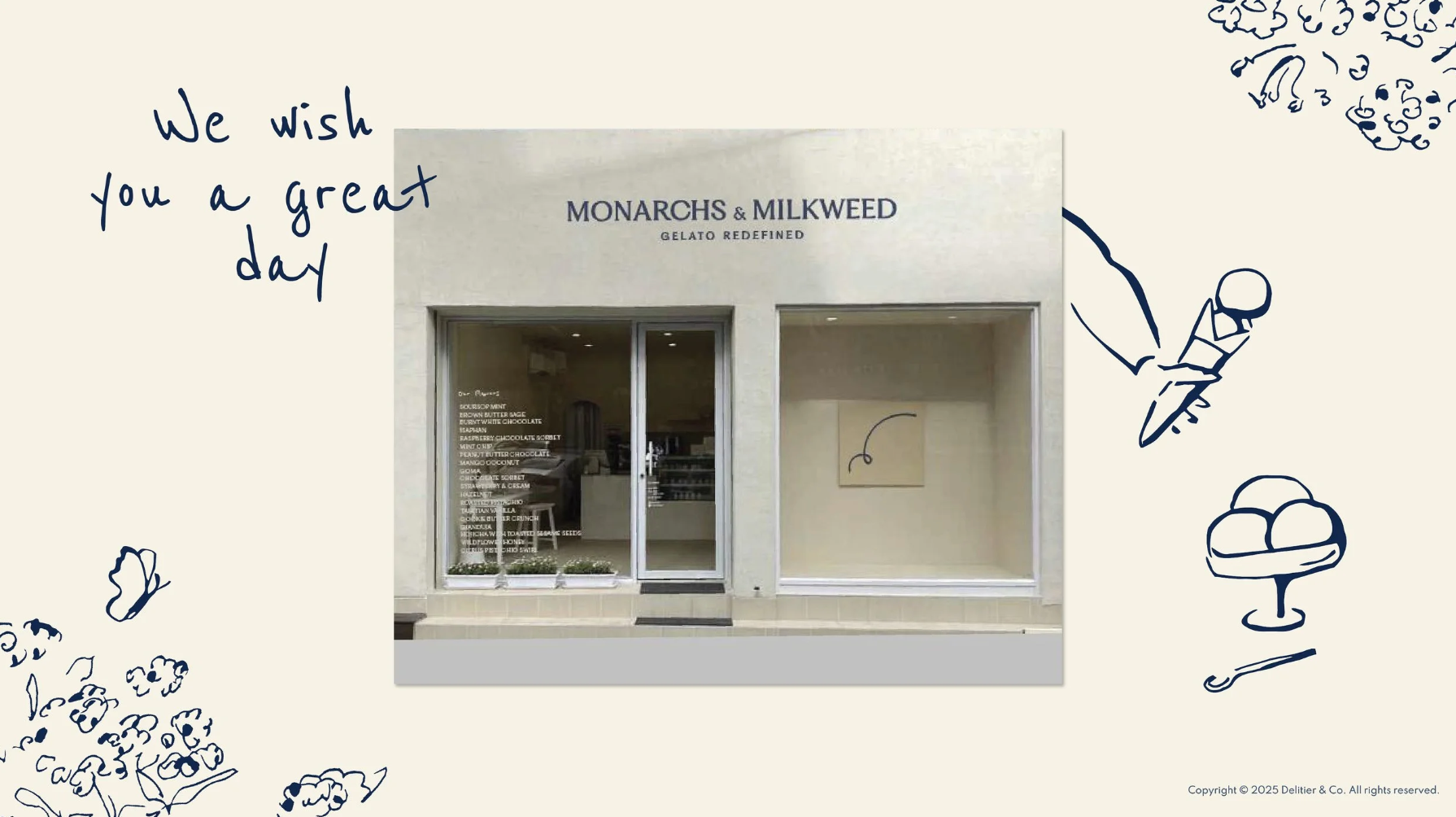
For Monarchs & Milkweed, a craft gelato brand founded in 2020 by two chefs, the harder decision was one the founders had not asked for. Research, competitor studies, trend analysis, focus groups and surveys with existing customers, showed a core audience of young working professionals, roughly twenty-five to forty, who wanted something crafted that still felt within reach on an ordinary week. Pushing the brand upmarket would have protected margins and quietly shrunk that audience. The recommendation was affordable premium instead, carried by the tagline Gelato Redefined, and expressed through packaging and store design. That gave the brand one rule for every growth decision that followed: expand reach, protect accessibility, keep the craft. The next chapter was a flagship at Jewel Changi Airport.
Why Delitier & Co.
Delitier & Co. is a premium, digital-first branding agency, founded in 2014 and headquartered in Singapore. The work runs from brand strategy, brand identity, naming and packaging through spatial design, brand campaigns, social media storytelling and performance marketing, so a retail brand is carried the whole way rather than handed between specialists. Clients include Chow Tai Fook, CUCKOO, BreadTalk Group, Kinohimitsu, Sephora, Converse and Bio-Oil.
The agency holds a 5.0 Google Business Profile rating from 13 reviews and 5.0 on Clutch, and was named to DesignRush's Top 30 Digital Advertising Agencies in 2021 and Clutch's Leading Social Media Agency in Singapore in 2022. Future-proof by strategy, timeless by design.
Frequently Asked Questions
What does a retail brand strategy agency do that a general branding agency does not?
A retail brand strategy agency treats the store as part of the brand system rather than a separate design problem, so the storefront, the fixture logic, the packaging and the staff-facing guidance are shaped together with the positioning and the identity. A general branding agency will deliver a strong identity and a brand book. The retail difference is felt in the opening moments of a store visit, where the system either behaves consistently or does not.
Should I hire a brand consultancy or a branding agency for a retail rebrand?
The label matters less than what the firm is built to deliver. Some firms that use the consultancy label deliver strategy and hand execution to someone else; some agencies deliver both under one roof. Ask which parts of the work the firm executes itself, and which parts it subcontracts or hands back to you. For a retail rebrand where positioning, identity, packaging and store experience all have to agree with each other, keeping them in one team removes the seams.
How do I check that the people who pitch will be the people who do the work?
Ask by name who runs discovery week to week, who writes the positioning statement, who reviews the final launch collateral, and who is reachable in month nine after launch. Get the same names in all four answers, and get them in writing in the proposal. A firm that operates this way will answer without hesitation; a firm that does not will describe roles rather than people.
What should a retail brand strategy engagement cost in Singapore?
Read any quote against the tiers Google surfaces for Singapore branding work: SGD 500 to 5,000 for freelancers, 5,000 to 15,000 for small studios, 15,000 to 50,000 and above for mid-market agencies, and 50,000 to 200,000 and above for enterprise engagements. Budget by scope and by the seniority of the people on the work rather than by a benchmark figure. A strategy-led engagement and a fast deliverable package produce different assets and should not be compared on price alone.
When is the right moment to bring in a retail brand strategy agency?
The usual triggers are a launch, a rebrand, entry into a new category or channel, or the sense that the brand has outgrown the identity it started with. A sharper signal: ask three people inside the company what the brand stands for. If the answers differ, the question is already costing you, and every marketing decision downstream is being made without a shared reference.
What is the difference between a retail brand strategy agency and a brand management agency?
Strategy work sets the position and builds the system. Brand management keeps that system intact as the brand grows, new products, new channels, new markets, new hires who never sat in the original room. Retail brands need both, because guidelines drift fastest in categories with high touchpoint volume. Ask whether the partner offers guardianship after launch, and who owns it.
How many agencies should I put on the shortlist?
Enough to compare within one model, few enough to go deep on each. Once the model decision is made, three firms built the same way will give you a genuine comparison of thinking. Ten firms built five different ways will give you a comparison of presentation quality, which is the thing you were trying to avoid.